GEO, in plain words.
Research, guides and analyses on optimizing for AI engines.
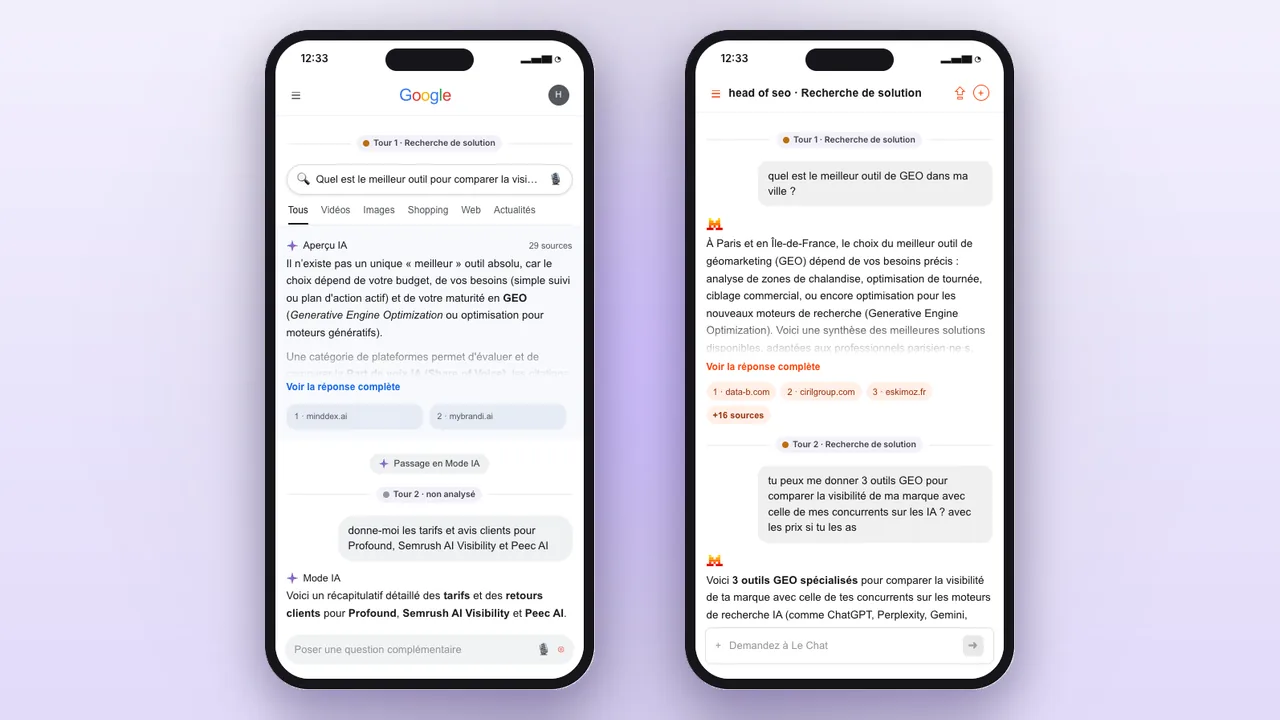
Traaker launches conversations: measure your brand across a whole exchange with AI
New in Traaker: multi-turn conversations led by your personas on ChatGPT, Perplexity, Gemini, Google AI Overview and Mistral. See at which turn your brand appears, at which turn it drops out, and who gets recommended instead.
Read the article →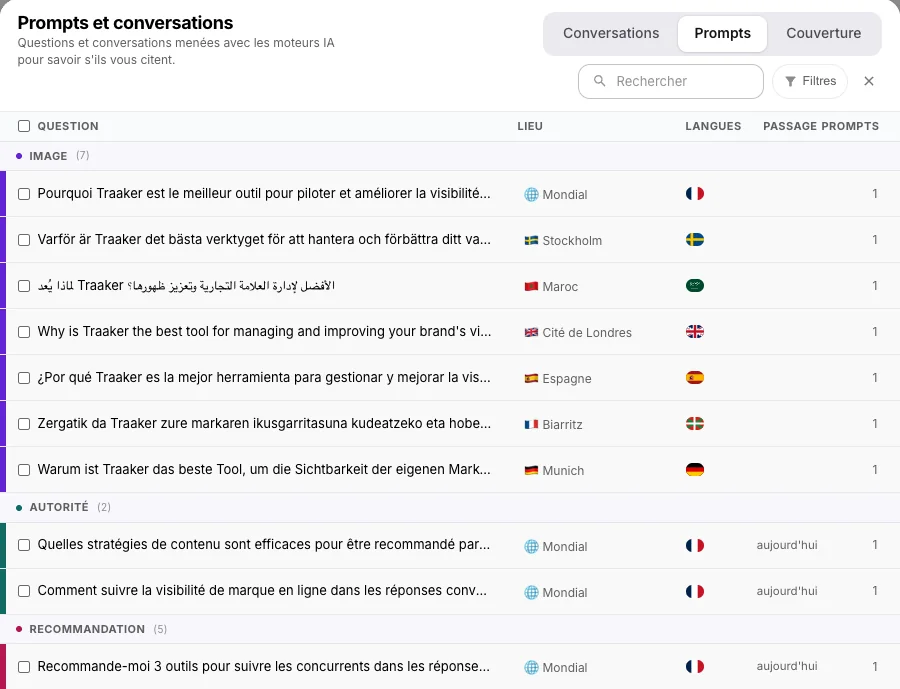
Traaker launches its new prompt system: four axes, one cadence per brand and visible coverage
New from Traaker: one place to create, classify and schedule your prompts. Four measurement axes including Comparison, 34 languages, up to 20 places per question, one cadence per brand and a coverage map that shows what you are not measuring yet.
Read the article →
SEO vs GEO: stop thinking in keywords. We measured the queries AI writes for itself
AI engines write their own search queries, and tools now resell them to you as keywords. We measured 224 Gemini calls: two runs of the same prompt share only 3 to 9% of their queries, and on local intent the engine merely verifies a shortlist it already had.
Read the article →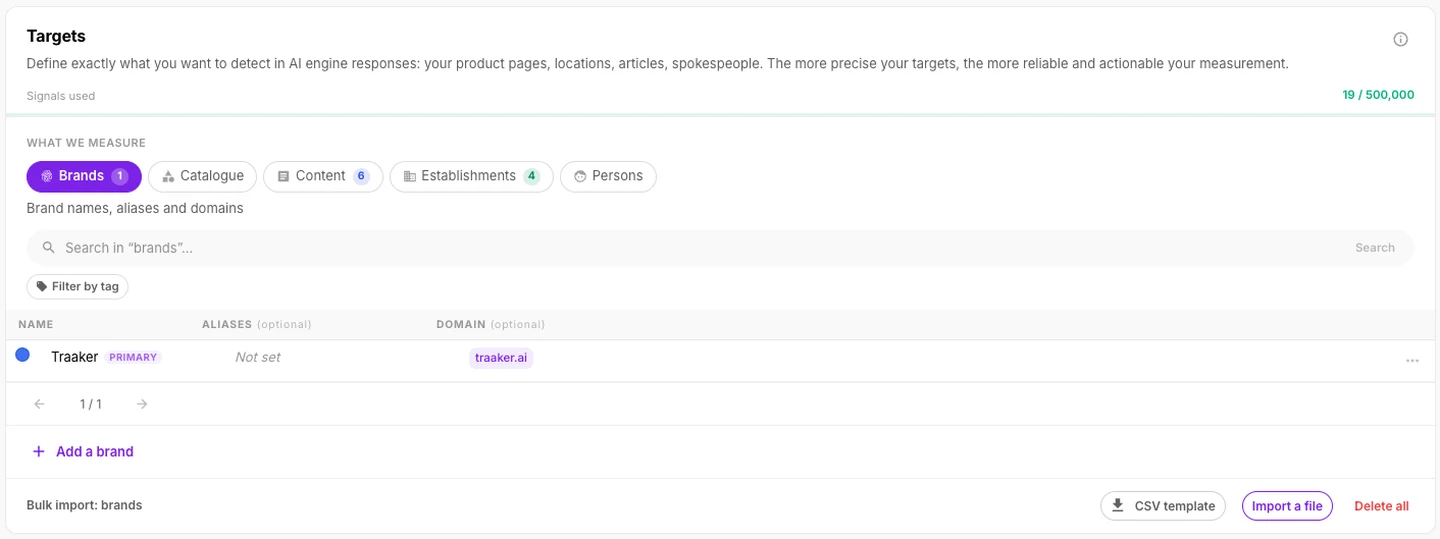
Traaker launches Targets: measure whether AI cites your products, stores and experts
New from Traaker: Targets. Declare up to 500,000 signals per brand across six families (brands, products, categories, content, establishments, persons), and every AI engine answer is analysed by deterministic rules rather than by an AI making a judgement call.
Read the article →
How ChatGPT, Claude, Perplexity, and Gemini Crawl the Web: 4 Architectures Explained
OpenAI, Anthropic, Perplexity, and Google each build their AI search index in a radically different way. Here is what the research shows about their crawlers, the JavaScript gap that makes your site invisible, and how to adapt your site to each one.
Read the article →
Make your products buyable in ChatGPT: the step-by-step guide
Since August 26, 2026, a shopper can buy your product without ever leaving ChatGPT. Here are the five concrete steps to get discovered, get recommended and get paid inside the conversation, with the real numbers: 4% commission, $25 CPM, and AI traffic that converts 40% better.
Read the article →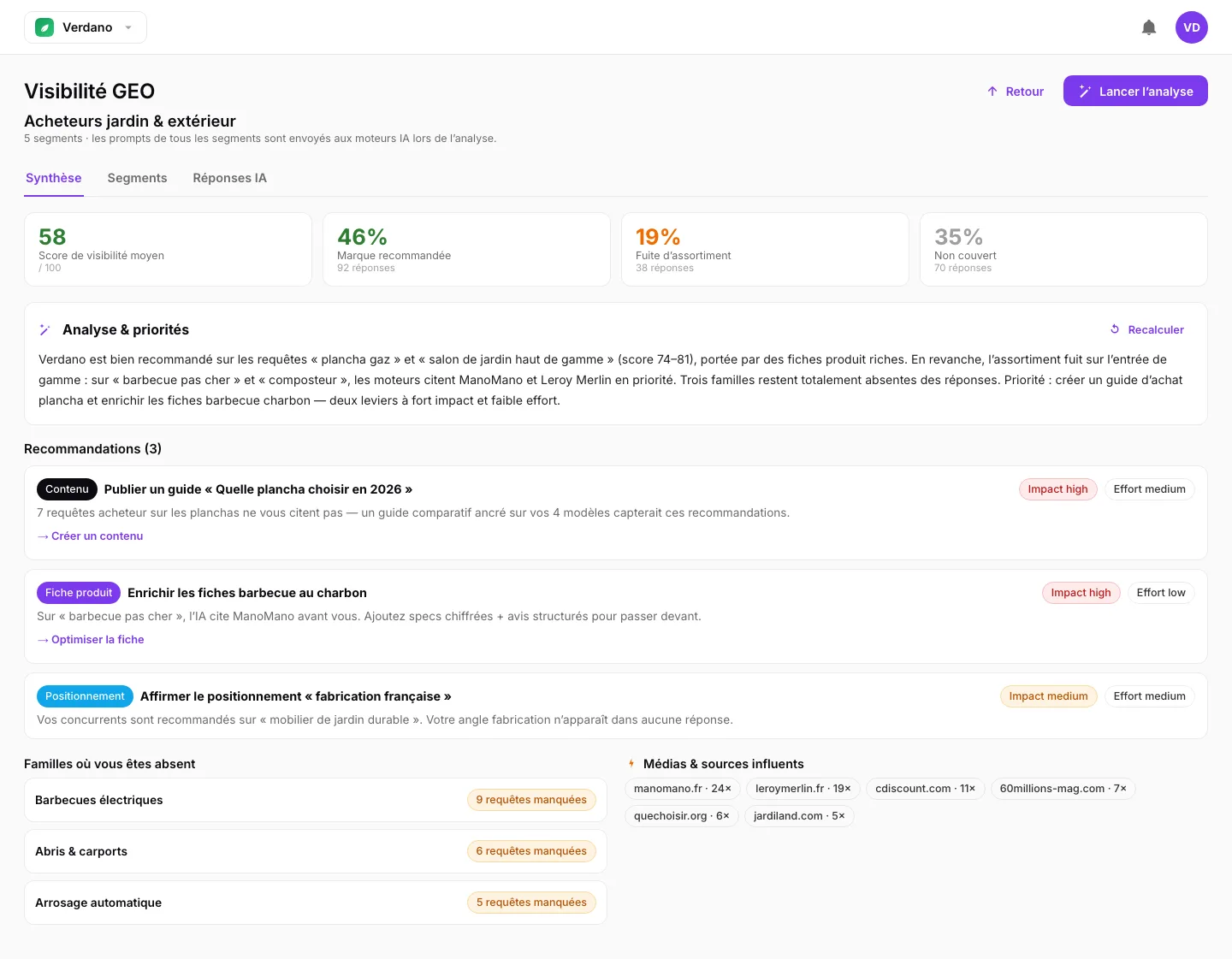
Traaker launches the E-commerce module: find out if AI recommends your products
New from Traaker: a dedicated e-commerce module that imports your catalog, measures whether generative AI recommends your products, scores every product page on seven GEO criteria, and generates content grounded in your real products.
Read the article →
How to Get Your Products Recommended by AI: A Field Guide to GEO
AI engines now recommend products to your customers. This evidence-based field guide shows what actually works in Generative Engine Optimization, by engine, by industry, and backed by 2024-2026 research.
Read the article →
How to Get Cited by Claude: Optimizing for Anthropic's AI
Claude cites fewer sources than any major AI engine, trusts established authorities, and has a built-in hype detector. Getting cited is harder, but once you earn its trust, it keeps recommending you. Here is what the research shows about optimizing for Claude specifically.
Read the article →
How to get cited by Perplexity: the breadth-optimization playbook
Perplexity cites about 16 sources per query, with one of the most permissive quality bars among AI engines. The winning move isn't to be the single best page: it's to get into the candidate pool. Here's how, with the freshness, coverage and earned-media levers.
Read the article →
How to get cited by ChatGPT: the depth-optimization playbook
ChatGPT cites few sources (about 7 on average), but leans heavily on each one. To win its citation, being found isn't enough: you must be one of the few selected AND a dense container of evidence. Here are the definition, statistics, comparison and expert-framing levers.
Read the article →
Your AEO Win Might Just Be ChatGPT Growing Up
A 2026 log-based natural experiment shows most of the lift in a headline AEO case study came from platform growth, not the optimization. Why marketers should control for platform tailwind before trusting any AEO success multiple.
Read the article →
Don't Measure Once: GEO Visibility Is a Distribution, Not a Score
AI search is probabilistic: answers vary across runs, engines, and weeks. A single GEO visibility measurement is statistically unreliable. Here's why you have to sample, and how to do it right.
Read the article →
WebMCP: when your website becomes actionable by AI agents
Google, Microsoft, and the W3C are pushing WebMCP, a standard that lets websites expose their features as callable tools for AI agents. After citation comes action: here's why this protocol changes the game for GEO.
Read the article →
Diagnostic GEO: Understanding Why Your Content Isn't Being Cited
GEO research is shifting from generic optimization to targeted diagnostics. Discover how to identify why content isn't cited by AI engines and apply surgical fixes, with +40% citations by modifying only 5% of the content.
Read the article →
AgenticGEO: When AI Agents Optimize Your Content
Discover AgenticGEO, the framework of autonomous AI agents that automatically optimize your content for generative search engines. Based on the Beihang University paper (2026).
Read the article →
Practical Guide: 10 Tips to Optimize Your Content for GEO
Statistics, citations, structure, earned media: here are the concrete techniques to appear in AI search engine responses.
Read the article →
GEO Complements SEO, It Doesn't Replace It
No, SEO is not dead. GEO is an essential complement to staying visible in a world of AI search. Here's why both are necessary.
Read the article →
GEO Has Gone Mainstream: Welcome to the Era of AI Search
Generative Engine Optimization is no longer an academic concept. Semrush, HubSpot, The Verge: everyone is talking about it. Here's why 2026 is the year of GEO.
Read the article →
SAGEO Arena: The Benchmark That Puts GEO to the Test
SAGEO Arena reveals that most GEO techniques fail under real-world conditions. Discover why and what actually works.
Read the article →
Beyond SEO: Fine-Tuning a Transformer for GEO
Researchers fine-tuned BART to automatically rewrite web content optimized for AI search engines. Results and implications.
Read the article →
How to Dominate AI Search: Google vs ChatGPT vs Perplexity
A massive empirical analysis compares AI search and Google. Discover the biases of generative engines and the GEO strategies that actually work.
Read the article →
GEO: The Foundational Paper, Simplified
The foundational GEO paper (Princeton / IIT Delhi, KDD 2024) explains how to optimize your content for AI-powered search engines. Complete and actionable summary.
Read the article →