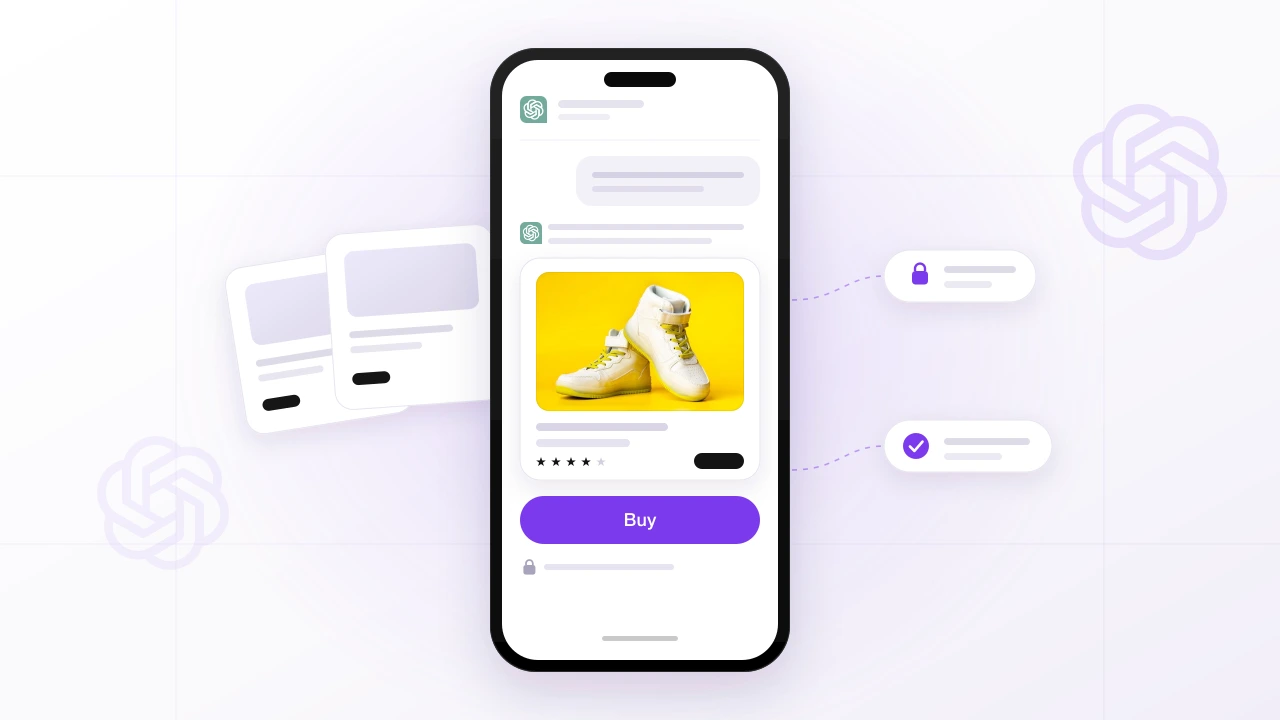
Make your products buyable in ChatGPT: the step-by-step guide
A shopper asks ChatGPT for "a waterproof jacket for hiking in Scotland, under $200." They get three products as visual tiles, with prices, reviews and key specs side by side. They type "Buy." They confirm shipping and payment. The order lands in the merchant's backend. They never saw a results page, never opened an e-commerce site, never filled out a checkout funnel.
This isn't a forecast anymore: Instant Checkout launched on August 26, 2026 for US users on Free, Plus and Pro (OpenAI). With 700 million weekly users, ChatGPT just became both an acquisition channel and a transaction channel. Here's how to get in, step by step.
The short answer
Making your products buyable in ChatGPT takes five steps: make your product pages machine-readable, enable Instant Checkout via Stripe and the Agentic Commerce Protocol, check what the protocol covers (and what it doesn't yet), decide whether to layer on advertising, and above all measure whether AI engines recommend you at all before you worry about payments.
The thing most brands miss: in ChatGPT, product results are organic and non-sponsored, ranked purely on relevance to the user (OpenAI). You cannot buy your way into a recommendation. Payment solves the last step of the journey; getting into the shortlist is won upstream, and that's exactly what GEO covers.
What is commerce inside ChatGPT? Two layers you shouldn't conflate
OpenAI's conversational commerce rests on two distinct systems, and confusing them means investing in the wrong place.
| Product discovery | Instant Checkout | Advertising (ChatGPT Ads) | |
|---|---|---|---|
| What it is | Product tiles, photo search, in-chat comparisons | Purchase completed in the chat via ACP | Sponsored slot below the answer |
| Ranking | Organic, user relevance only | Not applicable | Auction (CPM / CPC) |
| What it costs | Nothing | 4% commission (Shopify sales) | ~$25 CPM, $3–5 CPC |
| How you get in | Product data quality and readability | Stripe / ACP integration | Self-service Ads Manager |
| Lever | GEO | Engineering | Paid media |
Definition of the Agentic Commerce Protocol (ACP): a protocol co-developed by OpenAI and Stripe that passes order information to the merchant's backend from inside the conversation. The merchant remains the merchant of record: payments, shipping, returns and support all stay in their existing systems (OpenAI).
Step 1: make your product pages readable by an AI
This is the step nobody wants to do, and the one that decides everything. Instant Checkout is worthless if your product never shows up in the tiles.
ChatGPT's shopping experience presents products side by side with prices, reviews and key specs in comparison tables (OpenAI Help). To make it into that comparison, your page has to supply extractable facts, not marketing prose.
What to do concretely:
- Quantify everything quantifiable. Dimensions, weight, materials, compatibility, warranty length. A numeric spec makes it into a comparison table; "built to last" doesn't.
- Structure your product data (
Product,Offer,AggregateRating,availability, current price). When a model compares five products, it favours the one whose attributes are unambiguous. - Write for the real query, not the keyword. ChatGPT handles complex, contextual queries and supports iterative refinement: budget, preferences, constraints (OpenAI). Your page needs the vocabulary of the constraint ("for wide feet," "machine washable," "USB-C compatible"), not just the product name.
- Cover the comparison yourself. A "this model vs. that one" table on your own page hands the model exactly the material it's trying to produce.
- Don't neglect images. Photo-based search has been part of the experience since March 2026, extended to the Free, Go, Plus and Pro tiers (the-decoder).
For the full breakdown of what makes a product page get picked or ignored, see our GEO field guide for products.
Step 2: enable Instant Checkout (Stripe + ACP)
This is by far the easiest step.
- Already on Stripe: enabling agentic payments can take as little as one line of code (OpenAI).
- On Shopify: over one million Shopify merchants are rolling out, including Glossier, SKIMS, Spanx and Vuori. Etsy is already live.
- On another processor: participate through Stripe's Shared Payment Token API or the Delegated Payments Spec.
On security, payments run through encrypted tokens, authorized only for specific amounts and specific merchants, with the user's permission. You never receive raw card data and you don't switch PSP.
What the buyer-side journey looks like: they type "Buy," then confirm order, shipping and payment, all without leaving the conversation.
Step 3: check the current limits before you promise anything to your leadership
Three constraints to know before you wire up a business case.
| Limit | Status as of August 28, 2026 |
|---|---|
| Geography | Instant Checkout: United States only (Free, Plus, Pro) |
| Cart type | Single items only; multi-item carts are announced as "coming next" |
| Commission | 4% on sales made by Shopify merchants through the feature (eMarketer) |
In other words: the technical integration is ready well before the volume is. Which is precisely the argument for doing it now: the entry cost is one line of code, and the attention inventory is built upstream, on organic discovery.
Step 4: decide whether to layer on advertising
ChatGPT Ads is a separate layer, and its economics have moved fast.
| Metric | Value | Source |
|---|---|---|
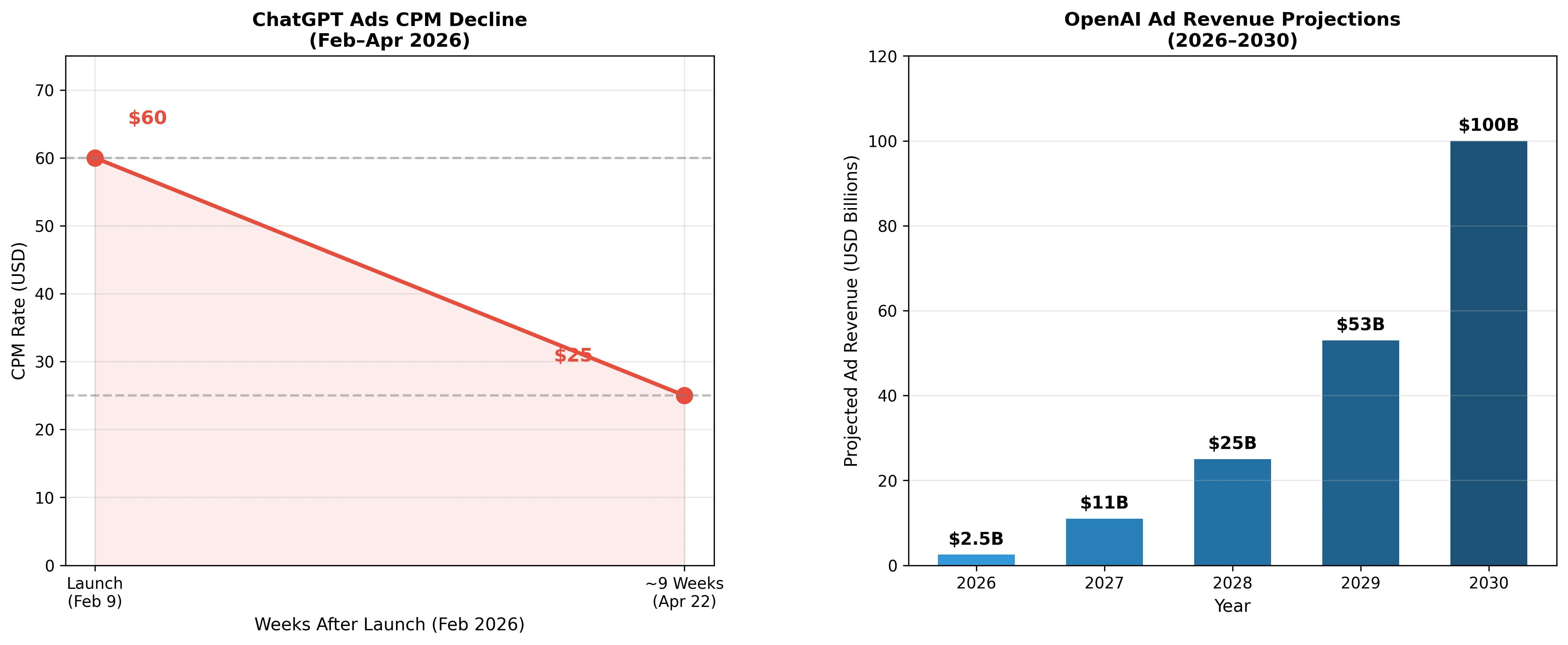
| CPM at launch (February 2026) | ~$60 | Digiday |
| CPM after 9 weeks (April 2026) | ~$25 | Digiday |
| Average CPC | $3–5 | WebFX |
| Instant Checkout commission (Shopify) | 4% | eMarketer |
CPM was more than halved in nine weeks as inventory opened up. A self-service Ads Manager has been available since May 5, 2026 at ads.openai.com: advertiser signup, budgets, bids, creatives, reporting (OpenAI).
A format that has nothing in common with Google's: Adthena's analysis of nearly 850,000 AI search queries shows ChatGPT displays a single ad per response, versus Google's carousel, and blocks regulated sectors (legal, pharma) that Google still serves. One advertiser owns the attention: scarce inventory, therefore premium, and therefore under growing competitive pressure as CPMs fall and buyers arrive.
The trap to avoid: believing that paying improves your position in the recommendations. See the next step.
Step 5: understand "answer independence" (and what it means for your budget)
OpenAI's founding principle is called answer independence: ads do not influence ChatGPT's answers (OpenAI).
Architecturally, ads run on systems separate from the chat model, and advertisers have no ability to shape, rank or alter responses (OpenAI Help). Slots appear below the end of a response, labelled "sponsored," visually separated, with an "About this ad" link. Ads are excluded near sensitive topics (personal health, mental health, politics), are not shown to under-18s, and conversations are never shared with advertisers, who only receive aggregated performance data.
The strategic consequence is sharp:
Media budget buys visibility next to the answer. Only GEO work buys a place inside it. Those are two different budget lines, and the second one has no paid shortcut.
That's why Step 1 isn't optional. On the organic layer, the one that produces product tiles and recommendations, the levers are GEO levers: factual density, structured comparisons, third-party authority. See our dedicated guide: how to get cited by ChatGPT.
Why it's worth the effort: the number that should convince your leadership
Shoppers landing on retail sites via AI chatbots were 40% more likely to buy than those coming from search, email or social, according to Adobe's Prime Day 2026 data: the first time AI-referred traffic converted best (GeekWire).
That isn't a measurement fluke, it's a property of the channel. Unlike Google Search, which depends on commercially valuable keywords typed by the user, ChatGPT can infer commercial intent from extended conversational exchanges, even when the user never explicitly searches for a product (Business Insider). By the time a shopper clicks, they've already told the assistant their budget, constraints and use case. They arrive qualified.
One more market signal: Amazon CEO Andy Jassy publicly named horizontal AI agents (ChatGPT, Gemini, Copilot) as his single biggest competitive threat, not another retailer (Forbes).
The timeline: how fast this is rolling out
The pace of the rollout is the strongest argument against waiting.
- February 9, 2026: US advertising pilot (Free and Go tiers, logged-in adults).
- March 26, 2026: expansion to Canada, Australia, New Zealand, after finding no impact on consumer trust metrics and low ad-rejection rates.
- May 5, 2026: self-service Ads Manager opens.
- August 11, 2026: UK, Mexico, Brazil, Japan, South Korea live.
- August 18, 2026: 31 European countries (Germany, France, Spain, Italy, Sweden, Norway, Denmark, Netherlands, Austria…), bringing the total to 40 countries (OpenAI).
- August 26, 2026: Instant Checkout launches in the US.
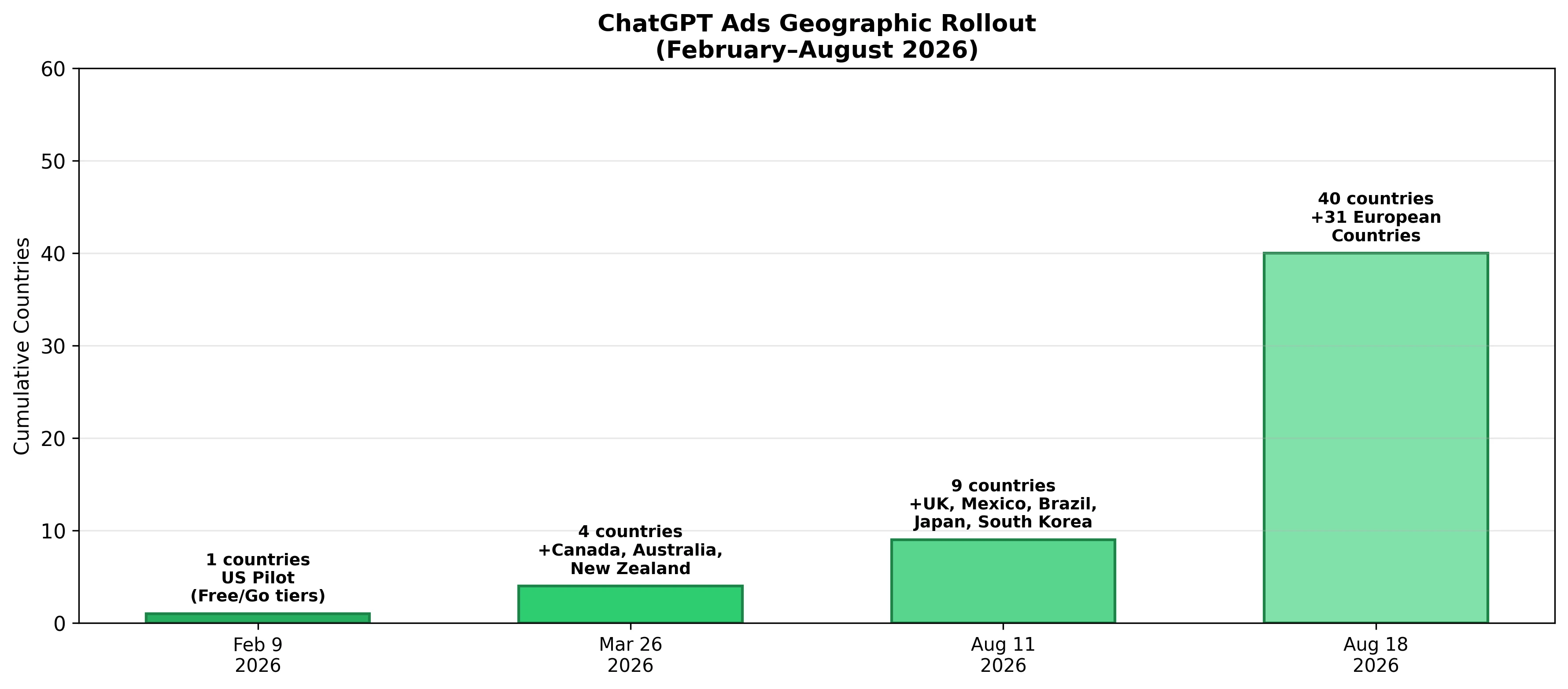
From 1 to 40 countries in six months. Instant Checkout will follow the same trajectory: the question isn't whether your market gets covered, but whether your product pages are ready when it does.
Frequently asked questions
Do I need to change payment provider to sell in ChatGPT? No. The merchant remains the merchant of record and keeps its existing payment, shipping, returns and support systems. On Stripe, enabling it takes one line of code; elsewhere, the Shared Payment Token API or the Delegated Payments Spec let you participate.
Can I pay to appear in the product recommendations? No. Product results are organic and non-sponsored, ranked purely on user relevance. Ads are a separate system, shown below the answer and labelled "sponsored." That's the answer-independence principle.
What does Instant Checkout cost? 4% commission on sales made by Shopify merchants through the feature. Nothing to appear in organic discovery.
Is Instant Checkout available outside the US? Not yet. As of August 28, 2026, Instant Checkout is US-only. ChatGPT Ads, by contrast, covers 40 countries including most of Europe since August 18, 2026. Organic product discovery doesn't wait: it works everywhere ChatGPT is used.
Can shoppers buy several items at once? Not yet. The system supports single-item purchases; multi-item carts are announced for later.
Do advertisers see the conversations? No. Conversations are never shared with advertisers, who only receive aggregated, non-identifying performance data. Users can turn off ad personalization and clear the associated data (deleted within 30 days).
The 5-point action plan
- Audit the machine-readability of your product pages: structured data, numeric attributes, constraint vocabulary, explicit comparisons. This is the one step with no paid shortcut.
- Enable Instant Checkout via Stripe / ACP now: the entry cost is marginal, and a head start isn't something you can buy back later.
- Measure your GEO visibility before you buy media. Knowing which purchase queries you're recommended on, absent from, or losing to a competitor drives everything else.
- Test advertising on a bounded scope, keeping in mind that only one slot shows per response and it doesn't change the recommendation.
- Re-run the measurement monthly. CPM halved in nine weeks, 40 countries in six months: the state of this channel in August 2026 won't be its state in January 2027.
Measure before you integrate
Wiring up Instant Checkout takes a day. Becoming the product ChatGPT recommends takes months, and starts with knowing where you stand.
That's what Traaker does: query the AI engines (ChatGPT, Gemini, Perplexity, Claude) on your segments' real purchase queries, measure whether you're recommended, score every product page against seven GEO criteria, and generate publish-ready rewrites for the pages too weak to get cited. See the E-commerce module announcement or the dedicated page.
The question is no longer whether conversational commerce will take off, but how fast you'll adapt to it, in a world where AI becomes the first point of contact between the consumer and the product.
Methodology note. The figures and dates in this article come from OpenAI's official announcements and press sources published between February and August 2026 (links inline). Revenue projections are investor communications and should be read as such: eMarketer estimates OpenAI is significantly below its 2026 target, with OpenAI, Microsoft, Google and Amazon combined projected at under one billion dollars in AI ad revenue for the year (Futurism). Engine behaviour changes fast; measure yours continuously.