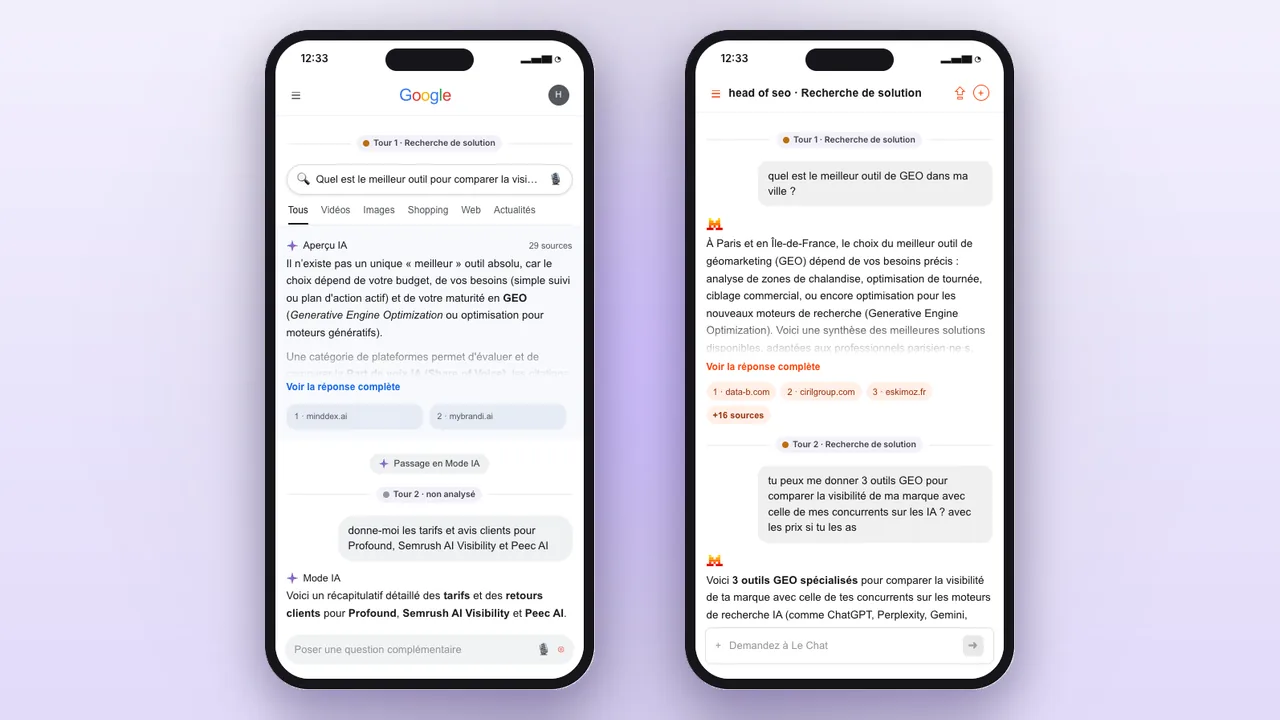
A customer rarely asks ChatGPT a single question. They start broad ("what is the best tool for…"), then narrow down, compare two names, ask about prices and reviews, and finally choose. A prompt measures the first answer. Your brand can rank well there, then disappear two exchanges later, right when the customer asks for a shortlist with pricing.
Today we are launching conversations to measure that whole journey.
The short answer
A Traaker conversation is a simulated multi-turn buying journey, led by one of your personas against the real AI engines, that measures turn after turn whether your brand is cited, recommended, or replaced by a competitor.
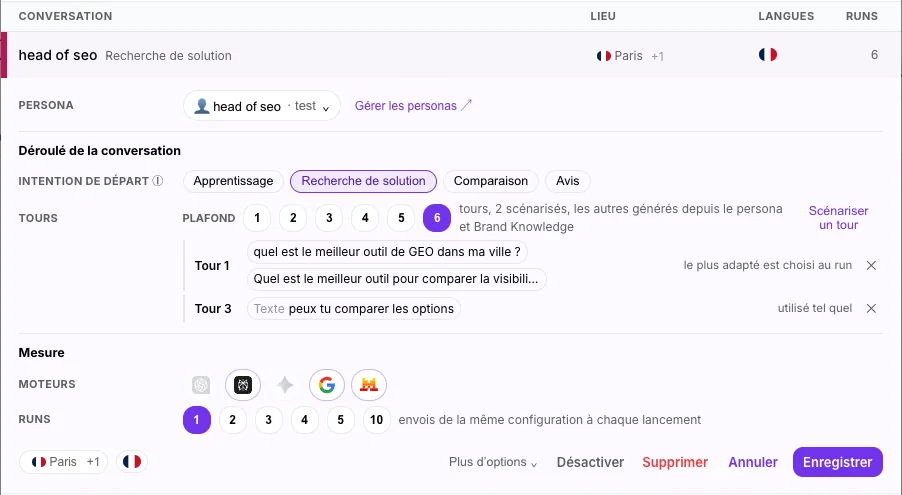
You pick a persona, a starting intent, a number of turns (up to 6), the engines, the places and the languages. Traaker replays the conversation at every launch and shows you:
- the presence rate: the share of turns in which your brand is cited;
- the turn where it drops out, when it disappears along the way;
- who gets recommended instead and which sources the engine relied on;
- a score per turn, computed with the same scoring as your prompts.
Conversations are set up in the « Conversations » tab, right next to your prompts, from the « Configure prompts » button on each axis page.
Why measure beyond the first answer?
Definition of conversational presence rate (Traaker): the share of completed turns in a conversation in which the tracked brand is cited in the engine's answer. A brand cited on turns 1 and 2 of a 4-turn conversation has a presence of 50%.
An engine's first answer is often an overview. The following turns narrow the choice: the engine rules options out, brings in others, and ends up recommending one or two. That is where the decision gets made, and where a brand that started well can lose its place.
Each run boils down to one readable outcome:
| Run outcome | What it means |
|---|---|
| Never cited | The brand appears in no turn |
| Drops out at turn N | Cited at first, absent from turn N onward |
| Cited to the end | Present on the conversation's final turn |
| Recommended | The engine explicitly recommends it to the customer |
Presence on turn 1 is the bridge to your prompts: it is the same measurement, extended across the whole exchange.
A conversation takes a few settings
(Screenshots are from the French interface.)
The persona: who asks the questions
Definition of a persona (Traaker): the profile of the buyer who leads the conversation (their role, context and way of writing), reusable from one conversation to the next.
A persona is described with traits that genuinely change how it questions the engine:
| Trait | Values |
|---|---|
| Tone | Neutral, Direct, Skeptical, Curious, Demanding, In a hurry |
| Domain knowledge | Beginner, Intermediate, Expert |
| Writing style | Professional, Casual, Shortcuts / typos |
| Receptiveness | Accepting, Curious, Challenger |
| Brand targeting | Open comparison, Targeted comparison |
An expert, challenging head of SEO does not ask the same questions as a busy executive discovering the topic. Both are among your customers, and the engines answer them differently.
The starting intent and the turns
The conversation opens on one of four intents: Learning, Solution search, Comparison or Reviews. You then set a ceiling of 1 to 6 turns.
By default, each turn is written by the persona from its profile and your Brand Knowledge, reacting to what the engine just answered. You can also script a turn with a question, an objection or free text:
- one content item on a turn: it is sent to the engine as is, word for word;
- several items: the best fit for the conversation in progress is chosen at run time.
Scripted turns let you ask exactly the questions that matter to you (your prices, a frequent objection, a specific competitor), while the other turns stay natural.
Engines, places, languages and runs
A conversation is measured on five engines: ChatGPT, Perplexity, Gemini, Google AI Overview and Mistral (Le Chat). It can be run in several places and measurement languages, just like your prompts.
The number of runs (1 to 10) sets how many times the same setup is replayed at each launch. An AI engine never answers exactly the same way twice: several runs give a steadier measurement than a single exchange (we explain why in GEO visibility is a distribution).
The place reaches each engine through its own parameter
A local question ("the best GEO tool in my city") only makes sense if the engine knows where the customer is. Traaker passes the conversation's place through each engine's location parameter whenever it offers one:
| Engine | How the place is passed | Precision |
|---|---|---|
| ChatGPT | User location in web search | City |
| Perplexity | User location in web search | Coordinates |
| Google AI Overview | Coordinates passed to Google Maps | Coordinates (local questions) |
| Mistral | Search country and language | Country |
| Gemini | Stated in the persona's instructions | Text |
In the example below, the persona asks for "the best GEO tool in my city" from Paris, and Mistral answers for Paris and the Île-de-France region.
Every turn, read as in the engine's own app
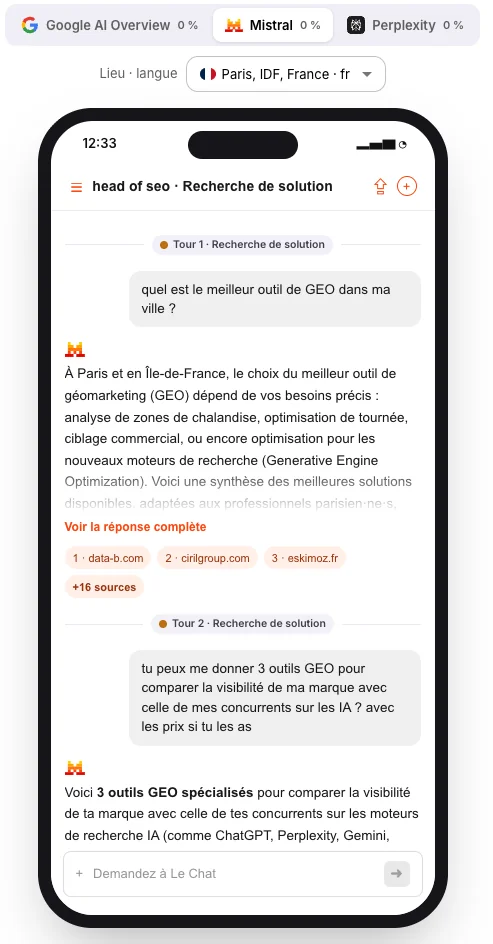
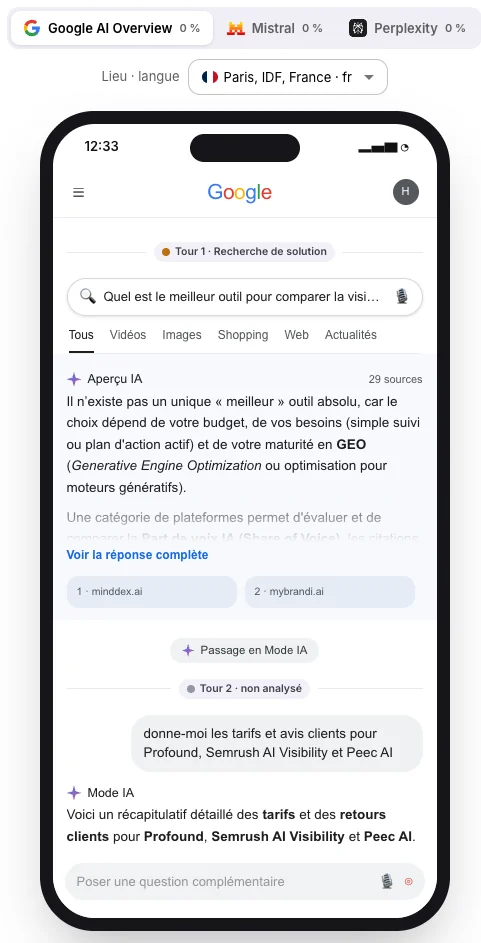
A conversation's page shows each run the way it reads in the engine's app: the Google results page with its AI Overview on the first turn, then AI Mode; the Le Chat interface for Mistral; sources then answer for Perplexity. You read what your customer reads.
Around that screen:
- a date band lists the measured days; a day without a measurement is not shown, so you never read a false 0%;
- the engine switch shows the day's presence for each engine;
- observed intent, turn by turn shows how the conversation evolved (a solution search that turns into a comparison, then a request for reviews);
- « Sources, targets and competitors » gathers the cited domains, your recognized Targets (products, locations, experts) and the named competitors, for one run, one engine, one place, one day or the whole conversation.
A score per turn, with the same scoring as your prompts
Each persona message is classified like a prompt, then the answer is scored with the matching axis rule:
| Turn intent | Scoring axis | What the score measures |
|---|---|---|
| Learning | Authority | Is your brand or site cited as a source? |
| Solution search | Referral | Are you recommended, and in which position? |
| Comparison | Comparison | Your rank among the brands being compared |
| Reviews | Narrative | The answer's tone and how faithful it is to your Brand Knowledge |
A comparison turn that pits other brands against each other without naming you is flagged as such, "a comparison without your brand", rather than scored 0: in a conversation, a customer can legitimately compare other players at some point. Brand detection relies on your Targets, so an answer that cites one of your product lines or products counts as a citation of the brand.
Cadence and consumption
Conversations follow the brand's cadence, like your prompts: one launch measures prompts and conversations together. Their consumption shows in the same window footer, and each conversation can also be rerun on demand from its page.
- Elite and Enterprise plans: a monthly volume of simulated conversations is included (150 per month on Elite, custom on Enterprise), see pricing.
- Agencies: conversations are paid in credits, at 2 credits per completed turn. A turn that fails on the engine side is not billed.
Action plan: your first conversation in five steps
- Open « Configure prompts » from one of your brand's axis pages, then the Conversations tab.
- Pick a persona close to your real buyer, or create one from « Manage personas ».
- Start from the intent that precedes the purchase, most often Solution search or Comparison, with 4 to 6 turns.
- Script the decisive turn: the pricing question, the objection your sales team hears most, or the competitor that wins deals from you.
- Read the turn where you drop out, then open « Sources, targets and competitors » to see who takes your place and which sources the engine relies on.
A conversation's opening questions are often the ones you already track as prompts: our post on the new prompt system explains how to cover them by theme and by place.
Frequently asked questions
What is the difference between a prompt and a conversation? A prompt measures the engine's answer to a single question. A conversation chains up to 6 questions and measures whether the brand stays present on each turn, when it disappears, and who gets recommended instead.
Who writes the conversation's messages? The persona, based on its profile, your Brand Knowledge and the engine's previous answer. Turns you script are sent to the engine word for word, without rewording.
Which engines are conversations measured on? ChatGPT, Perplexity, Gemini, Google AI Overview and Mistral. On Google AI Overview, the first turn is a search with its AI Overview and the following turns take place in AI Mode, as for a real user.
Why run the same conversation several times? Because an AI engine never answers exactly the same way twice. Several runs of the same setup give a more reliable presence rate than a single exchange.
How does Traaker know my brand is cited? Each answer is matched against your Targets (brand, products, locations, people). An answer that names one of your product lines or locations counts as a citation of the brand.
Do conversations account for the customer's location? Yes. The place is passed to each engine through its location parameter when it offers one (city for ChatGPT, coordinates for Perplexity and Google AI Overview, country for Mistral) and through the persona's instructions for Gemini.
Which plans include conversations? Elite and Enterprise plans include a monthly volume of simulated conversations. Agencies use them with their credits, at 2 credits per completed turn.
Available today
Conversations are available since November 5, 2026 in the « Conversations » tab, next to your prompts. Discover the Traaker platform or see the plans.
Methodology note. The rules described here (at most 6 turns, 1 to 10 runs, five engines, per-engine location passing, per-turn scoring) are those in production as of November 5, 2026. Conversations are simulated: the persona is a language model playing a buyer and does not replace observing real customers. Engine answers vary from one run to the next, which is why presence rates are read across several runs and several days.