Traaker launches the E-commerce module: find out if AI recommends your products
A shopper opens ChatGPT and asks: "which gas plancha should I get to host the whole family?" They get three names back, with reasons. No results page, no ten blue links to compare, just an answer, with a handful of products inside it. The question that matters is no longer "am I well ranked?" but "am I on the list?"
Until now, Traaker measured that dynamic very well at the level of a brand and its showcase website. But a catalog of ten thousand SKUs isn't a ten-page showcase site, and "are you cited" says nothing about "which of your ten thousand products, on which query, against which competitor." Today we're launching the E-commerce module to answer exactly that.
"I've never seen that from any other platform." Fabrice, Head of SEO/GEO at an e-commerce platform
The problem we hadn't solved yet
AI engines have changed how people shop, and the digital shelf has gotten shorter. Where Google used to hand back a results page the shopper explored themselves, an AI assistant now filters on their behalf and keeps only a handful of products. Being present or absent from that short list has a direct effect on sales, but until now, no tool let an online retailer know:
- whether their products are being recommended by AI engines on their shoppers' real queries,
- which of their ten, hundred, or hundred-thousand product pages are clear enough for an AI to understand and cite,
- and above all, what to fix: not an abstract diagnostic, but a rewrite ready to publish.
Classic SEO answers "can I be found." GEO (Generative Engine Optimization) answers "am I understood, and chosen." For a product catalog, that's a fundamentally different question, at a scale that general-purpose GEO tools don't address.
What the E-commerce module does
Catalog import, no technical integration
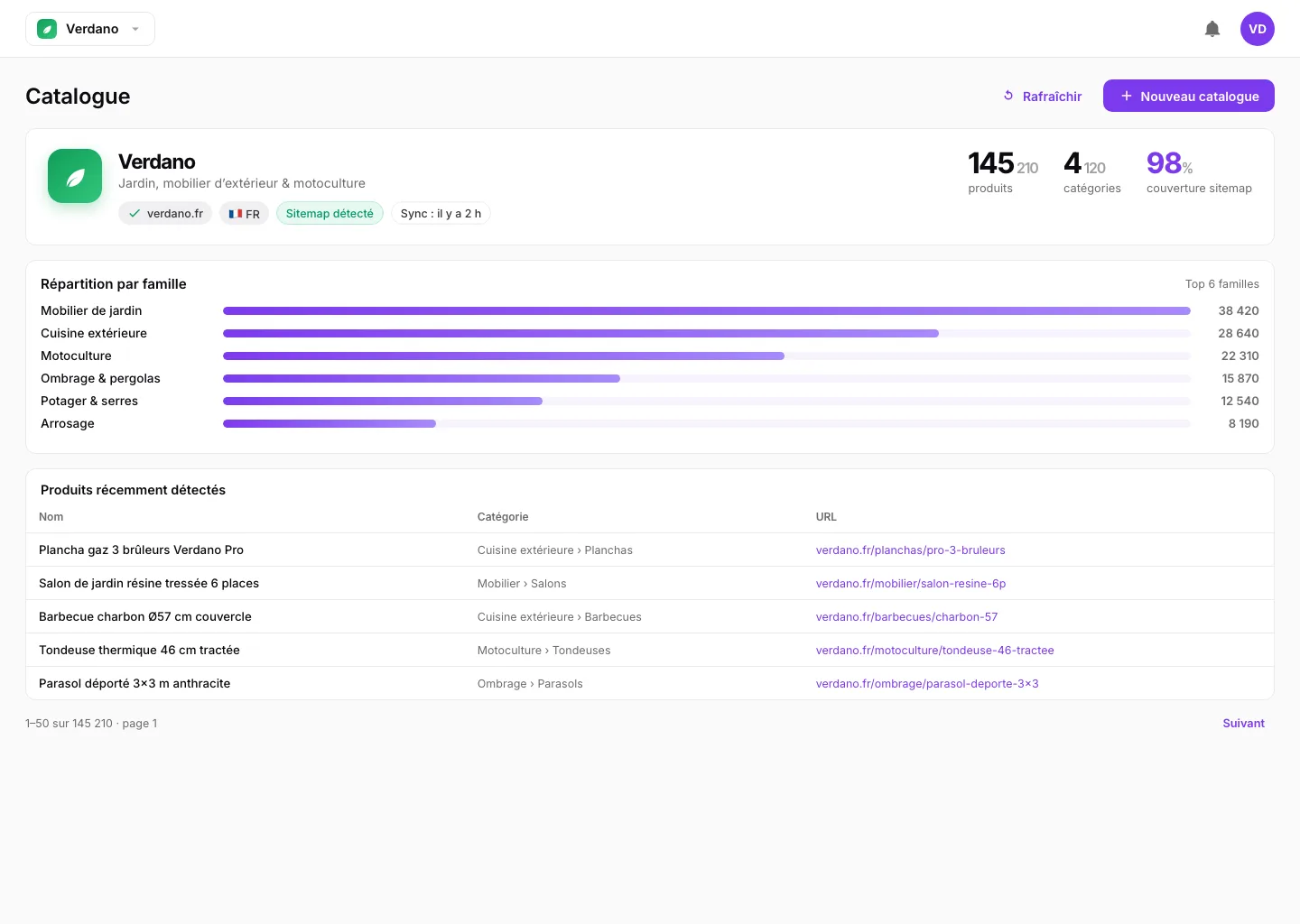
Give it your site's URL: Traaker detects the sitemap and automatically imports your products and categories, up to 145,000+ SKUs, or via a simple CSV file. A controllable scope (include/exclude rules by category) and a refresh that detects new and delisted items on every sync.
A GEO score for every product page
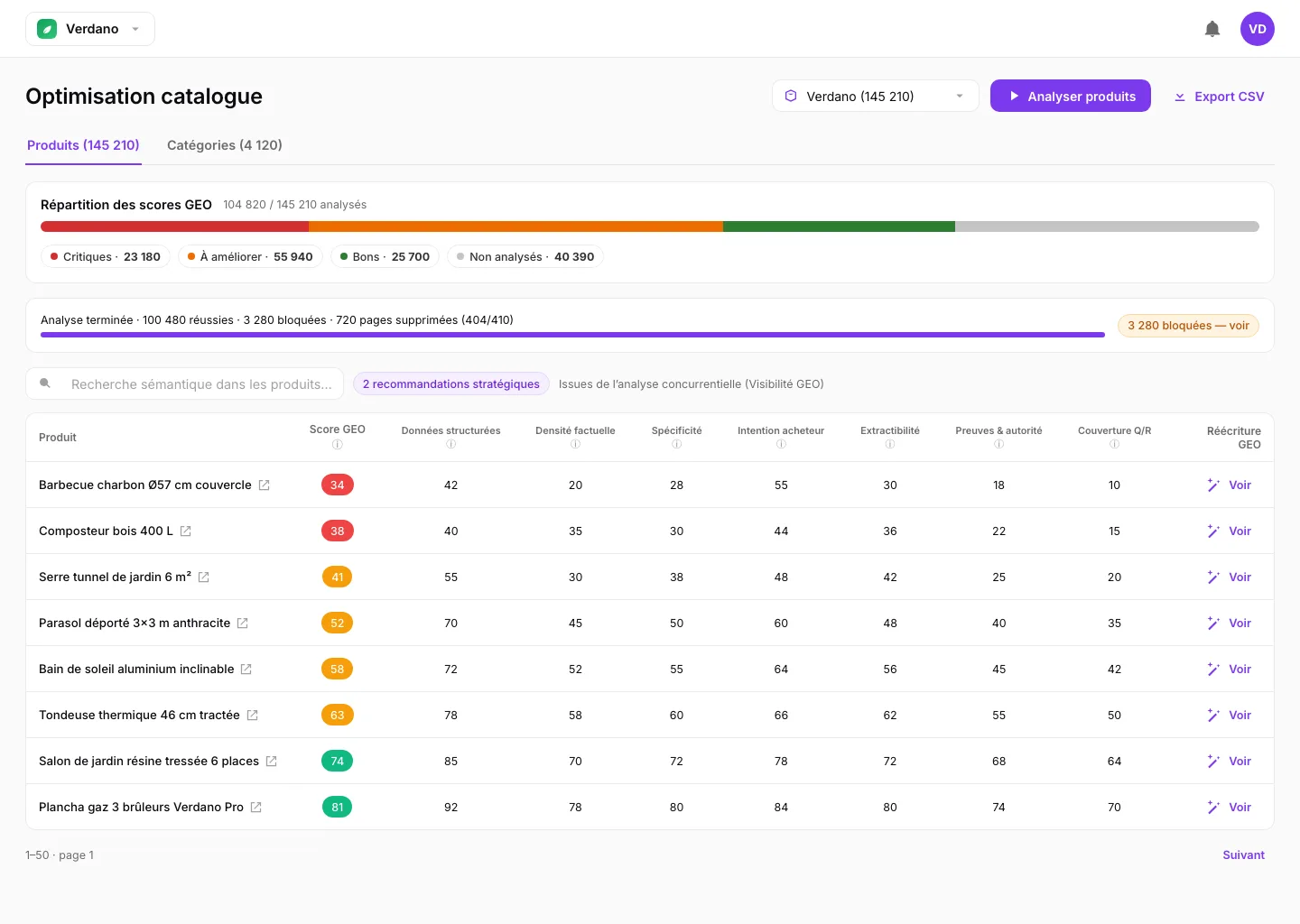
Each page is scored on seven criteria that determine whether an AI can understand and recommend it: structured data, factual density, specificity, purchase intent, extractability, evidence & authority, Q&A coverage. Pages rank worst-to-best so you tackle the critical ones first, and every weak page gets a ready-to-publish rewrite (arguments, quantified specs, FAQ), exportable as CSV back into your PIM or CMS.
Shopper segments, not keywords
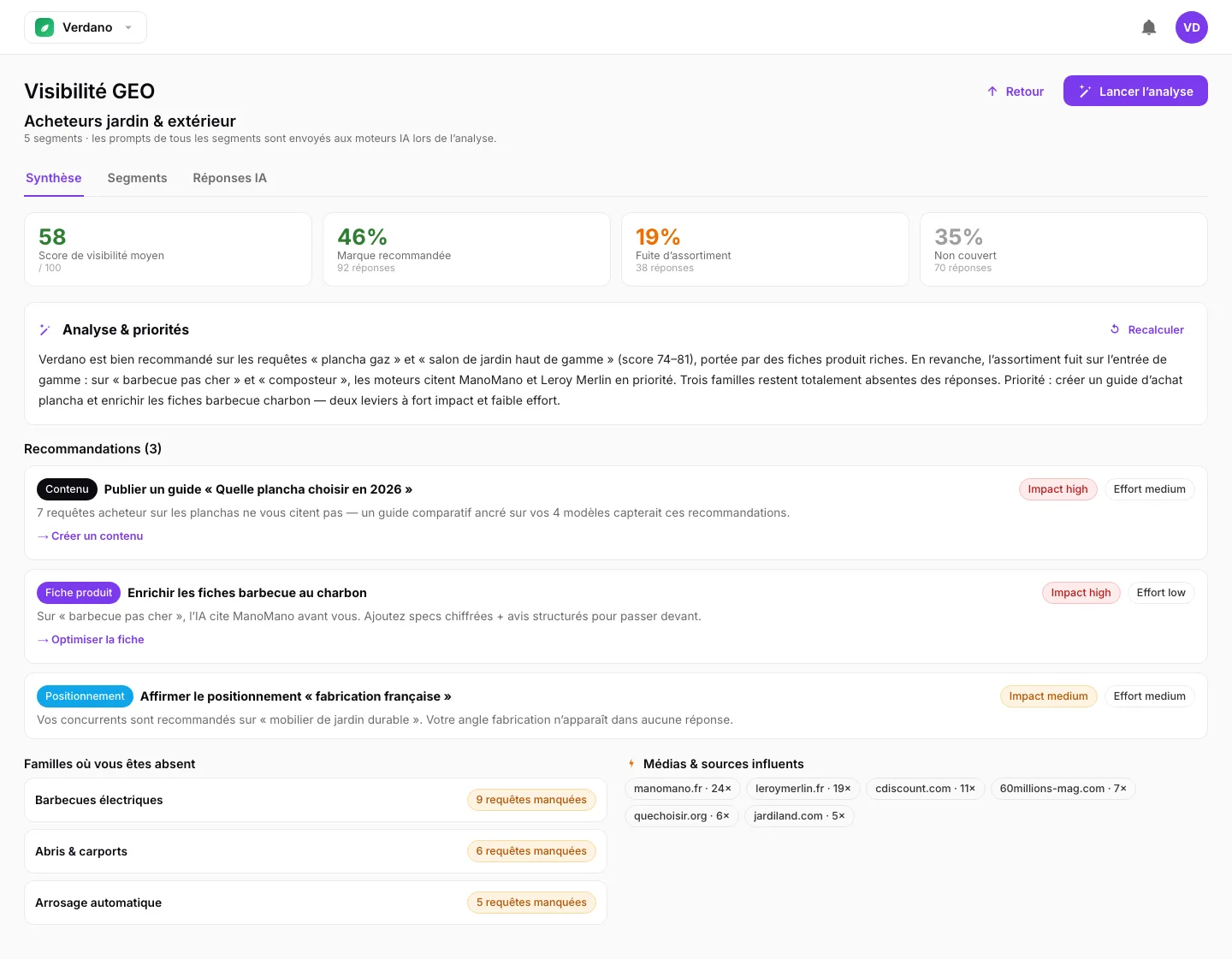
Describe a customer in plain language: who they are, what they're looking for, how they buy. Traaker derives their real purchase queries, in the languages and on the engines that matter to you. Each query is then matched to the closest product in your catalog via semantic search.
GEO visibility measurement
Traaker queries the AI engines (ChatGPT, Gemini, Perplexity, Claude depending on your plan) on each segment's queries and measures whether you're recommended, whether a competitor edges you out, or whether you're simply absent. You get a visibility score per segment with its trend over time, the queries where you're losing ground to a competitor, and the product families with weak presence.
Content grounded in your real products
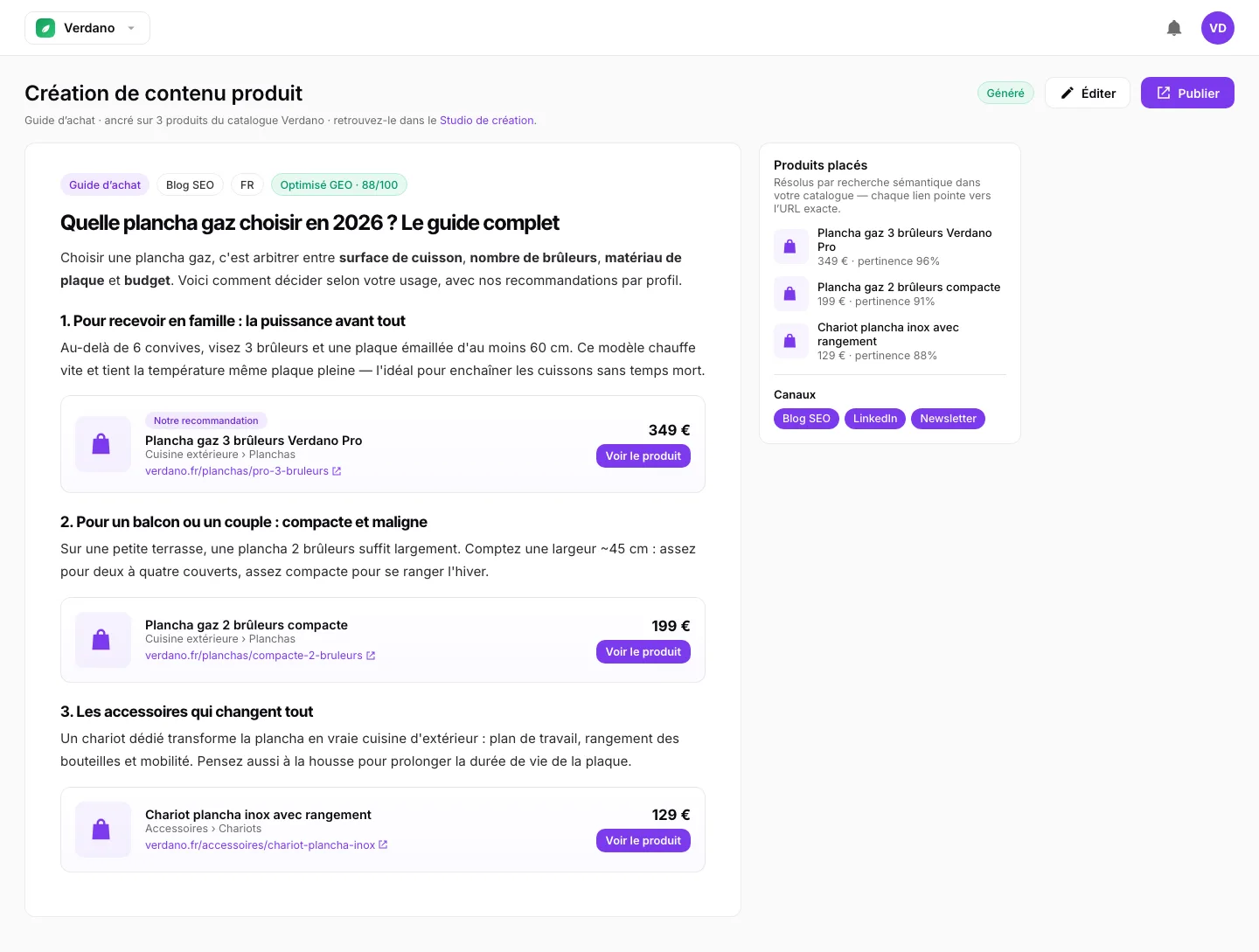
On the queries where the analysis finds you absent, Traaker generates the content that puts you back in the running: a buying guide, a comparison, an editorial piece, with your real products placed inside the body of the article. Every link points to the exact URL of your product page, resolved by semantic search inside your own catalog. The model never invents a URL.
Who it's for
- E-commerce & DTC: your catalog is your revenue. Know which queries you're recommended on, and turn your weak pages into citable ones.
- Marketplaces: tens of thousands of SKUs. The GEO score scales and prioritizes the categories where AI visibility matters most for sales.
- Manufacturers & brands: even without selling direct, make sure AI describes your products accurately, and feed the engines pages that hold up.
A full loop, not just tracking
A tool that only tells you you're losing citations doesn't solve anything. The E-commerce module closes the loop: from measurement to the corrected page, all the way to published content that wins back the queries where you were absent. It's the same logic that structures all of Traaker, applied at the scale of an entire catalog instead of ten showcase pages.
The module is available today. Book a demo to see your own catalog imported and your first pages flagged for fixing, or check out the dedicated page for full feature details.